Design Competition for Archstorming 2024

Prototype Community Center in India
Design Proposition
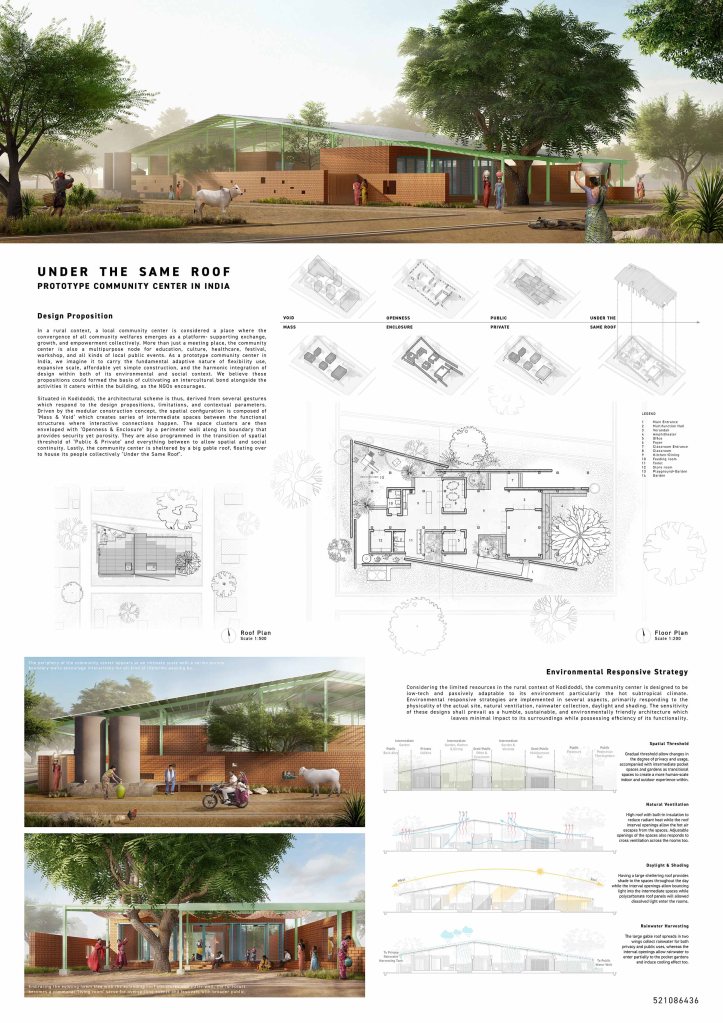
In a rural context, a local community center is considered a place where the convergence of all community welfares emerges as a platform- supporting exchange, growth, and empowerment collectively. More than just a meeting place, the community center is also a multipurpose node for education, culture, healthcare, festival, workshop, and all kinds of local public events. As a prototype community center in India, we imagine it to carry the fundamental adaptive nature of flexibility use, expansive scale, affordable yet simple construction, and the harmonic integration of design within both of its environmental and social context. We believe these propositions could formed the basis of cultivating an intercultural bond alongside the activities it caters within the building, as the NGOs encourages.
Situated in Kodidoddi, the architectural scheme is thus, derived from several gestures which respond to the design propositions, limitations, and contextual parameters. Driven by the modular construction concept, the spatial configuration is composed of ‘Mass & Void’ which creates series of intermediate spaces between the functional structures where interactive connections happen. The space clusters are then enveloped with ‘Openness & Enclosure’ by a perimeter wall along its boundary that provides security yet porosity. They are also programmed in the transition of spatial threshold of ‘Public & Private’ and everything between to allow spatial and social continuity. Lastly, the community center is sheltered by a big gable roof, floating over to house its people collectively ‘Under the Same Roof’.
Environmental Responsive Strategy
Considering the limited resources in the rural context of Kodidoddi, the community center is designed to be low-tech and passively adaptable to its environment particularly the hot subtropical climate. Environmental responsive strategies are implemented in several aspects, primarily responding to the physicality of the actual site, natural ventilation, rainwater collection, daylight and shading. The sensitivity of these designs shall prevail as a humble, sustainable, and environmentally friendly architecture which leaves minimal impact to its surroundings while possessing efficiency of its functionality.
Spatial Design Strategy
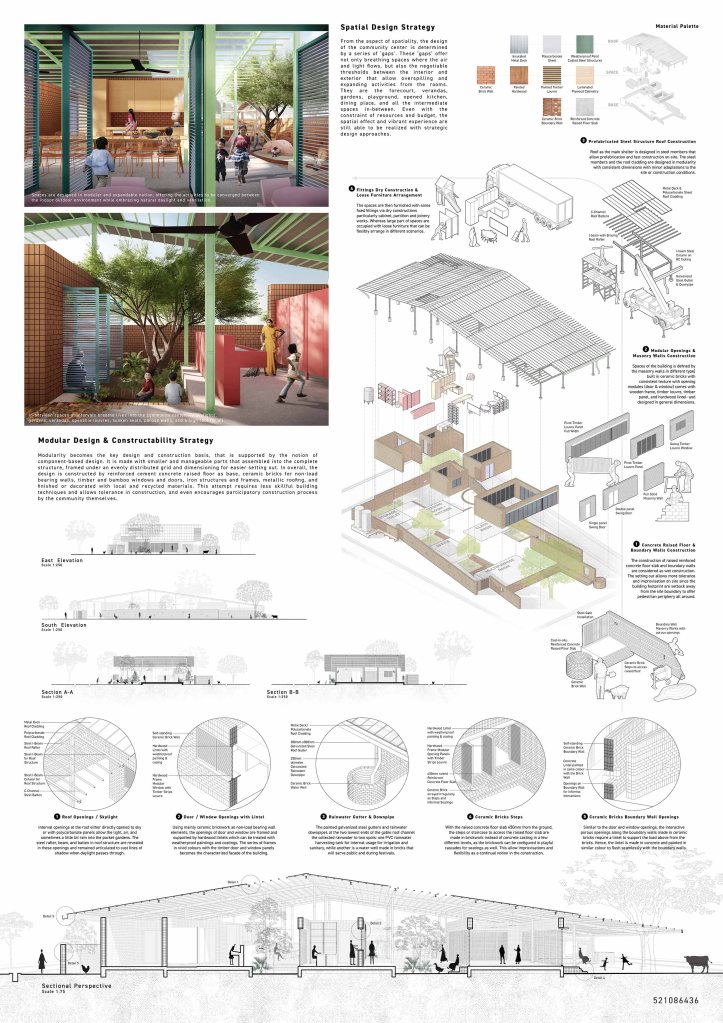
From the aspect of spatiality, the design of the community center is determined by a series of ‘gaps’. These ‘gaps’ offer not only breathing spaces where the air and light flows, but also the negotiable thresholds between the interior and exterior that allow overspilling and expanding activities from the rooms. They are the forecourt, verandas, gardens, playground, opened kitchen, dining place, and all the intermediate spaces in-between. Even with the constraint of resources and budget, the spatial effect and vibrant experience are still able to be realized with strategic design approaches.
Modular Design & Constructability Strategy
Modularity becomes the key design and construction basis, that is supported by the notion of component-based design. It is made with smaller and manageable parts that assembled into the complete structure, framed under an evenly distributed grid and dimensioning for easier setting out. In overall, the design is constructed by reinforced cement concrete raised floor as base, ceramic bricks for non-load bearing walls, timber and bamboo windows and doors, iron structures and frames, metallic roofing, and finished or decorated with local and recycled materials. This attempt requires less skillful building techniques and allows tolerance in construction, and even encourages participatory construction process by the community themselves.
 arch.yiyang