2nd Place, Buildner’s Microhome Competition 2024/25
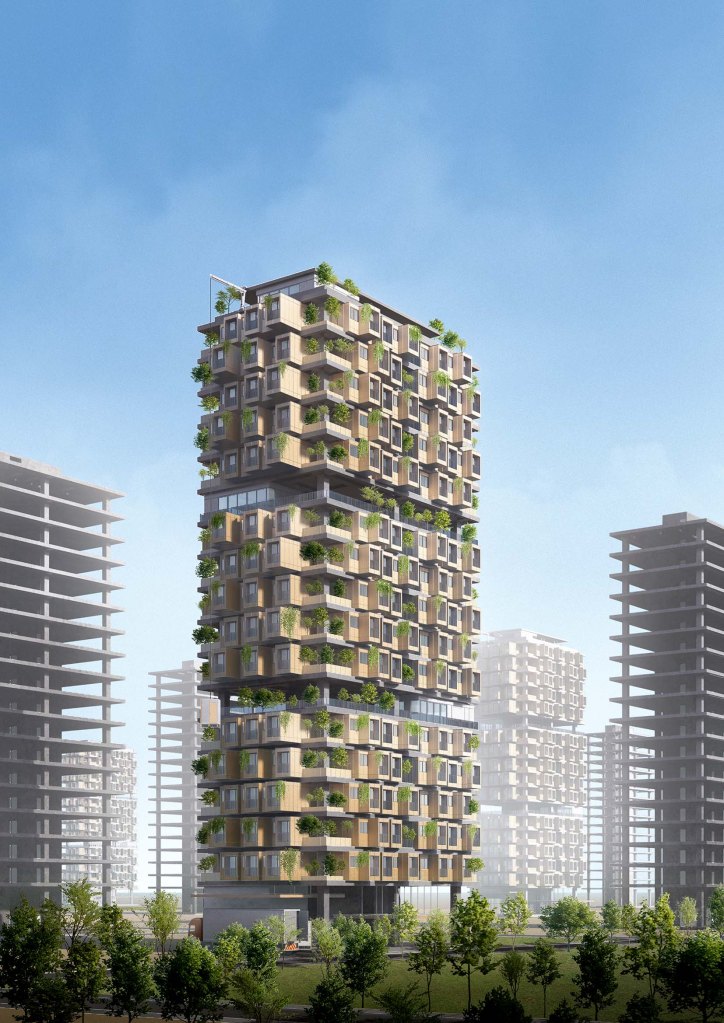
Re-inhabit Ghost Structures
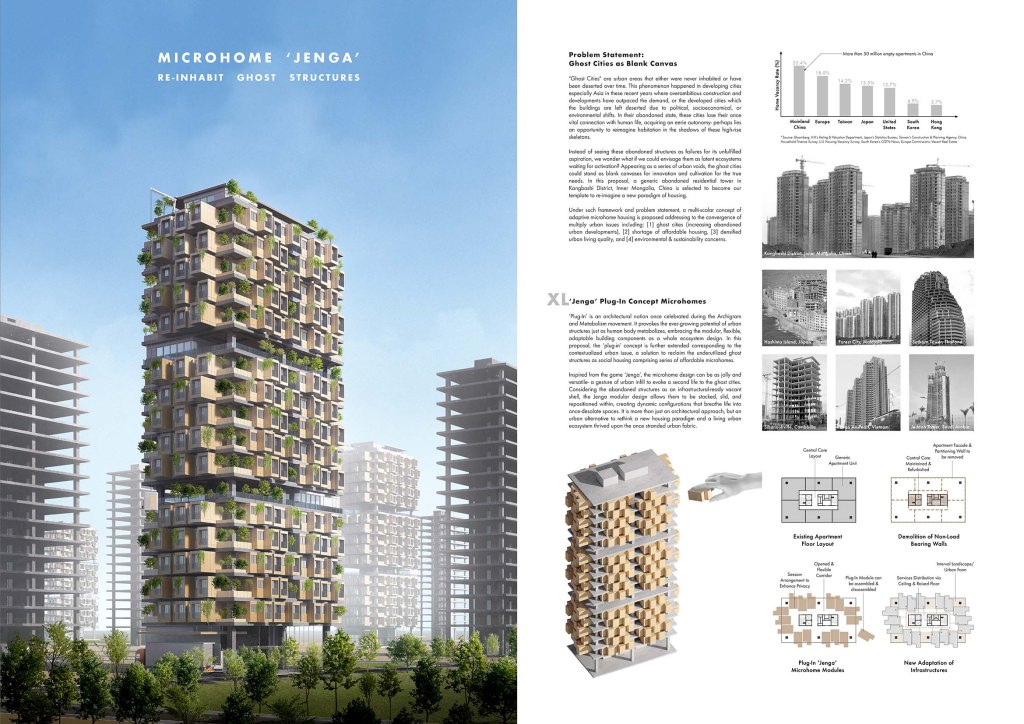
Problem Statement: Ghost Cities as Blank Canvas
“Ghost Cities” are urban areas that either were never inhabited or have been deserted over time. This phenomenon happened in developing cities where overambitious construction and developments have outpaced the demand, or the developed cities which the buildings are left deserted due to political, socioeconomical, or environmental shifts. In their abandoned state, these cities lose their once vital connection with human life, acquiring an eerie autonomy- perhaps lies an opportunity to reimagine habitation in the shadows of these high-rise skeletons.
Instead of seeing these abandoned structures as failures for its unfulfilled aspiration, we wonder what if we could envisage them as latent ecosystems waiting for activation? Appearing as a series of urban voids, the ghost cities could stand as blank canvases for innovation and cultivation for the true needs. In this proposal, a generic abandoned residential tower in Kangbashi District, Inner Mongolia, China is selected to become our template to re-imagine a new paradigm of housing.
Under such framework and problem statement, a multi-scalar concept of adaptive microhome housing is proposed addressing to the convergence of multiply urban issues including: [1] ghost cities (increasing abandoned urban developments), [2] shortage of affordable housing, [3] densified urban living quality, and [4] environmental & sustainability concerns.
XL: ‘Jenga’ Plug-In Concept Microhomes
‘Plug-In’ is an architectural notion once celebrated during the Archigram and Metabolism movement. It provokes the ever-growing potential of urban structures just as human body metabolizes, embracing the modular, flexible, adaptable building components as a whole ecosystem design. In this proposal, the ‘plug-in’ concept is further extended corresponding to the contextualized urban issue, a solution to reclaim the underutilized ghost structures as social housing comprising series of affordable microhomes.
Inspired from the game ‘Jenga’, the microhome design can be as jolly and versatile- a gesture of urban infill to evoke a second life to the ghost cities. Considering the abandoned structures as an infrastructural-ready vacant shell, the Jenga modular design allows them to be stacked, slid, and repositioned within, creating dynamic configurations that breathe life into once-desolate spaces. It is more than just an architectural approach, but an urban alternative to rethink a new housing paradigm and a living urban ecosystem thrived upon the once stranded urban fabric.
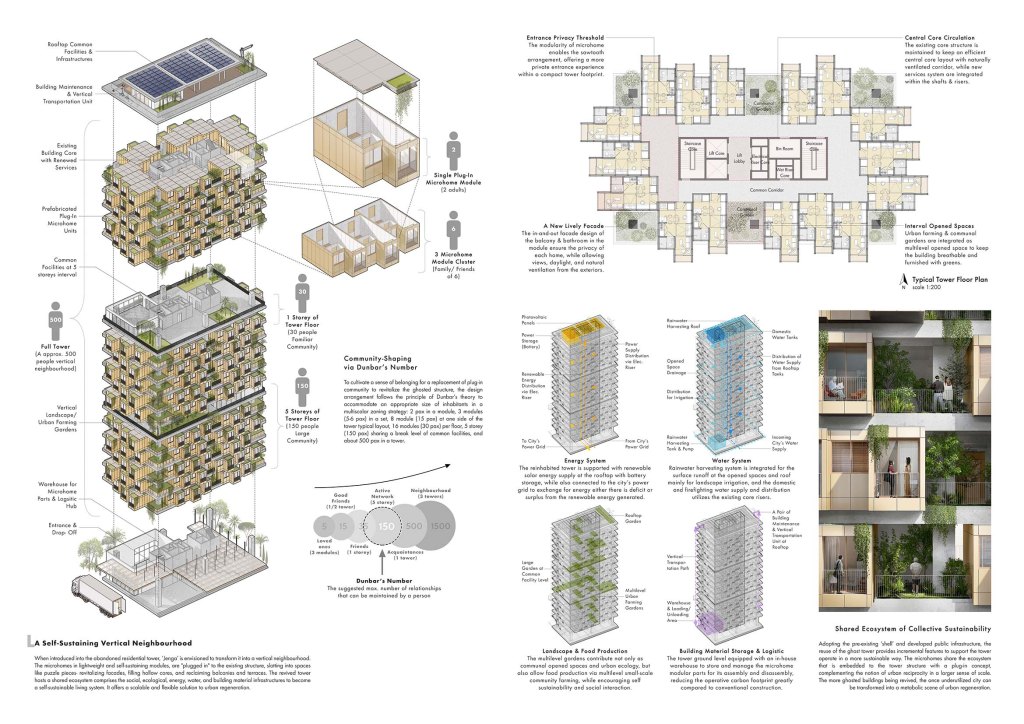
L: A Self-Sustaining Vertical Neighbourhood
When introduced into the abandoned residential tower, ‘Jenga’ is envisioned to transform it into a vertical neighbourhood. The microhomes in lightweight and self-sustaining modules, are “plugged in” to the existing structure, slotting into spaces like puzzle pieces- revitalizing facades, filling hollow cores, and reclaiming balconies and terraces. The revived tower hosts a shared ecosystem comprises the social, ecological, energy, water, and building material infrastructures to become a self-sustainable living system. It offers a scalable and flexible solution to urban regeneration.
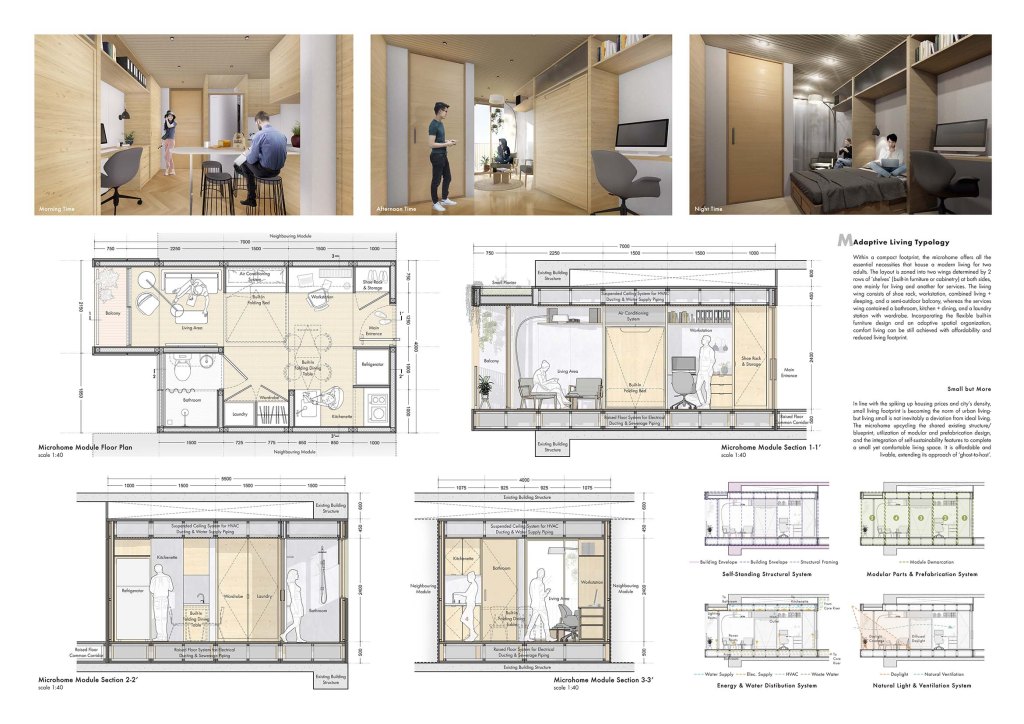
M: Adaptive Living Typology
Within a compact footprint, the microhome offers all the essential necessities that house a modern living for two adults. The layout is zoned into two wings determined by 2 rows of ‘shelves’ (built-in furniture or cabinetry) at both sides, one mainly for living and another for services. The living wing consists of shoe rack, workstation, combined living + sleeping, and a semi-outdoor balcony, whereas the services wing contained a bathroom, kitchen + dining, and a laundry station with wardrobe. Incorporating the flexible built-in furniture design and an adaptive spatial organization, comfort living can be still achieved with affordability and reduced living footprint.
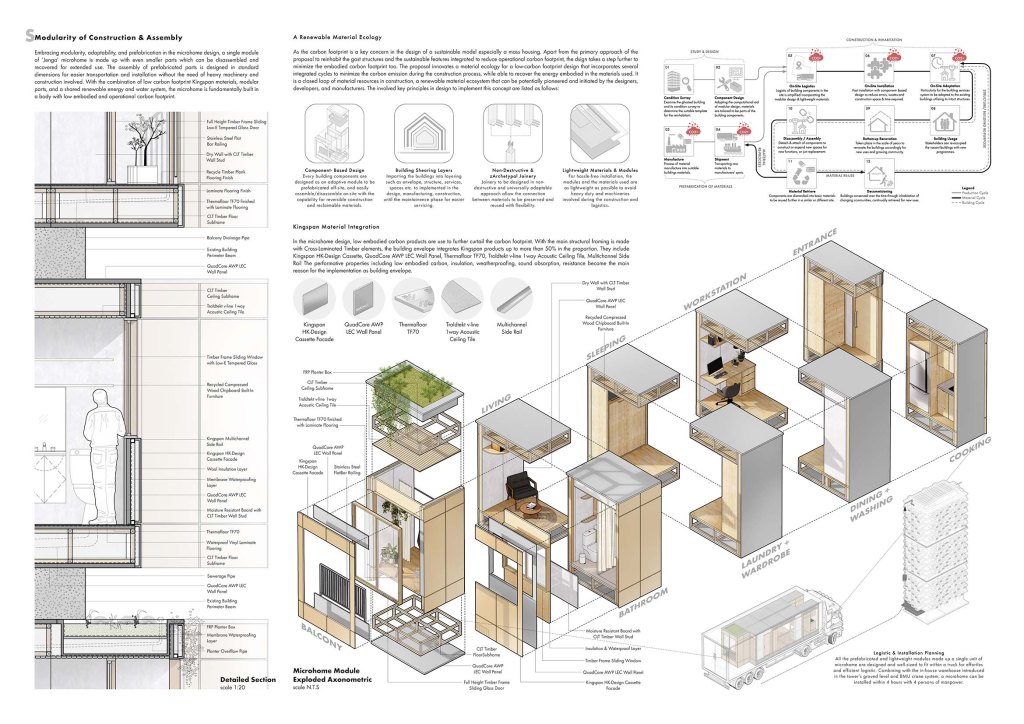
S: Modularity of Construction & Assembly
Embracing modularity, adaptability, and prefabrication in the microhome design, a single module of ‘Jenga’ microhome is made up with even smaller parts which can be disassembled and recovered for extended use. The assembly of prefabricated parts is designed in standard dimensions for easier transportation and installation without the need of heavy machinery and construction involved. With the combination of low carbon footprint Kingspan materials, modular parts, and a shared renewable energy and water system, the microhome is fundamentally built in a body with low embodied and operational carbon footprint.
 arch.yiyang