Merit, FuturArc Prize 2024
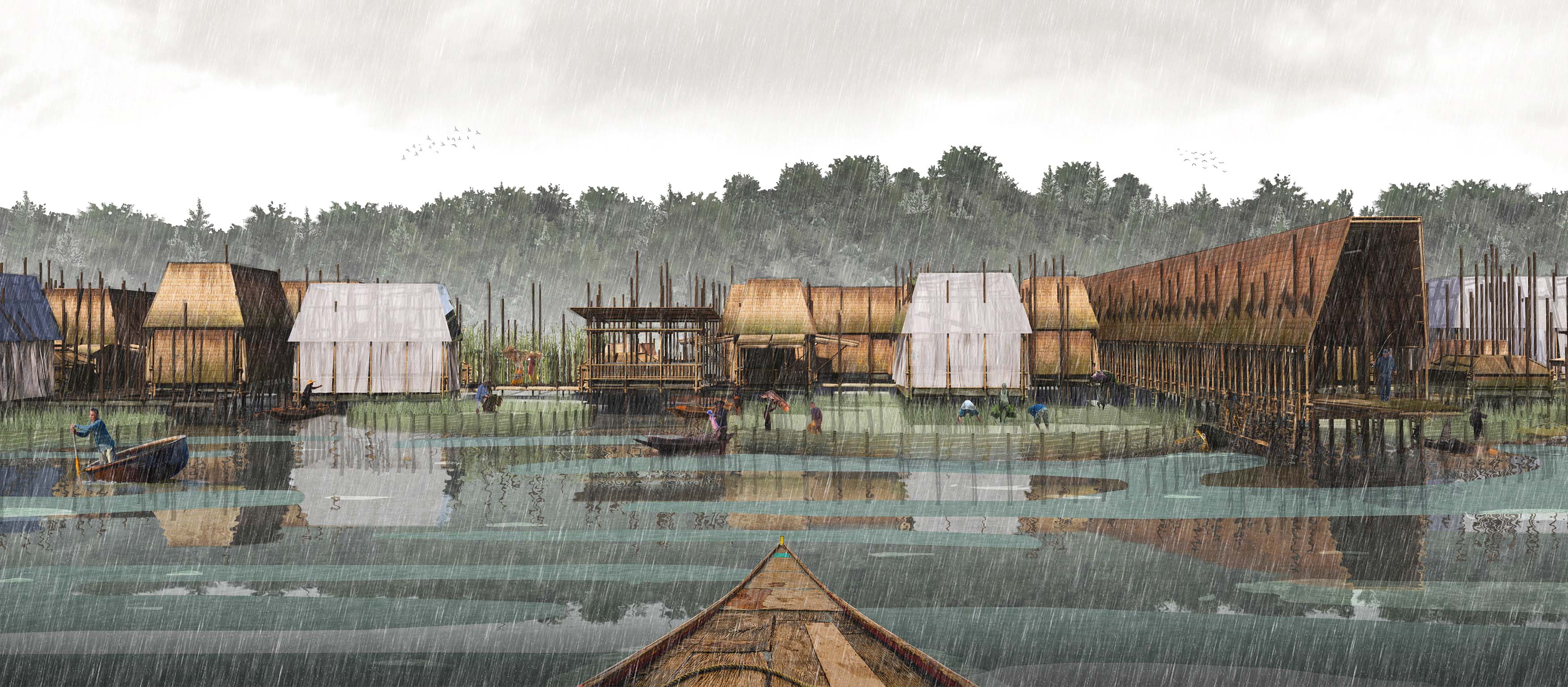
Design Resilient Community in Tawi-Tawi Islands
Project Context: At the Verge of Land and Sea
Made of a total 7641 islands, Philippines with its unique archipelago geography – is considered one of the most environmentally vulnerable country highly prone to natural disasters. Apart from the regularly affected by volcano activity, landslides and floods, Philippines sits astride typhoon belt and struck averagely by 20 cyclonic storms per year. Located along the Mindanao Trench found with frequent seismic activity, Philippines is risked to destructive earthquakes which might results in tsunamis too. Its islandic landform also exposed itself to the threat of rising sea level. The internal human-caused issues from uncontrolled deforestation, soil erosion, severe air and water pollution are making the country even worse of its vulnerability.
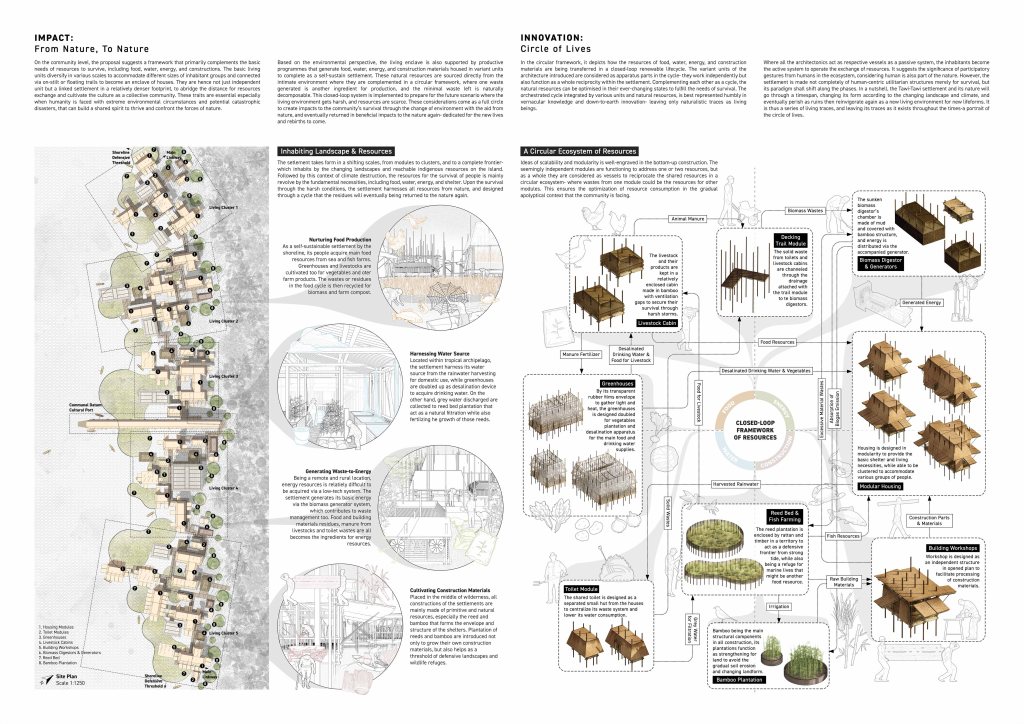
As a speculative proposal responds upon the global catastrophic climate scene, the project takes place to re-imagine a resilience and adaptive community at the shoreline Tawi-Tawi Island- a remote volcanic origin and organic island in Philippines. To be situated within an almost primitive environment, the project is set at the premise to adapt, survive, and perhaps perish or evacuate along the timeline of changing climate. At the same time, the project can serve as an alternative approach to reflect on the climate adaptation of Philippines or broader context across the globe which shares the similar hazards. Considering the site as an environmentally sensitive place from the local to climatic scales, we wonder how the way of living could be- for all kinds of lifeform to acclimatize in the scene of perishing and rebirth, at the verge between the land and sea?
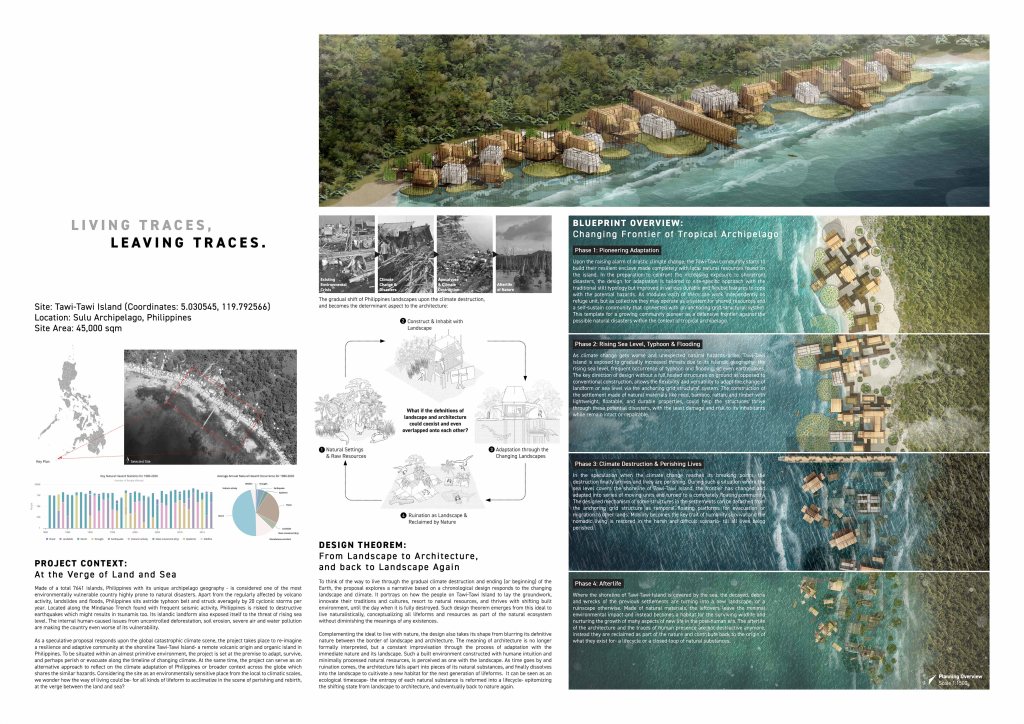
Design Theorem: From Landscape to Architecture, and back to Landscape Again
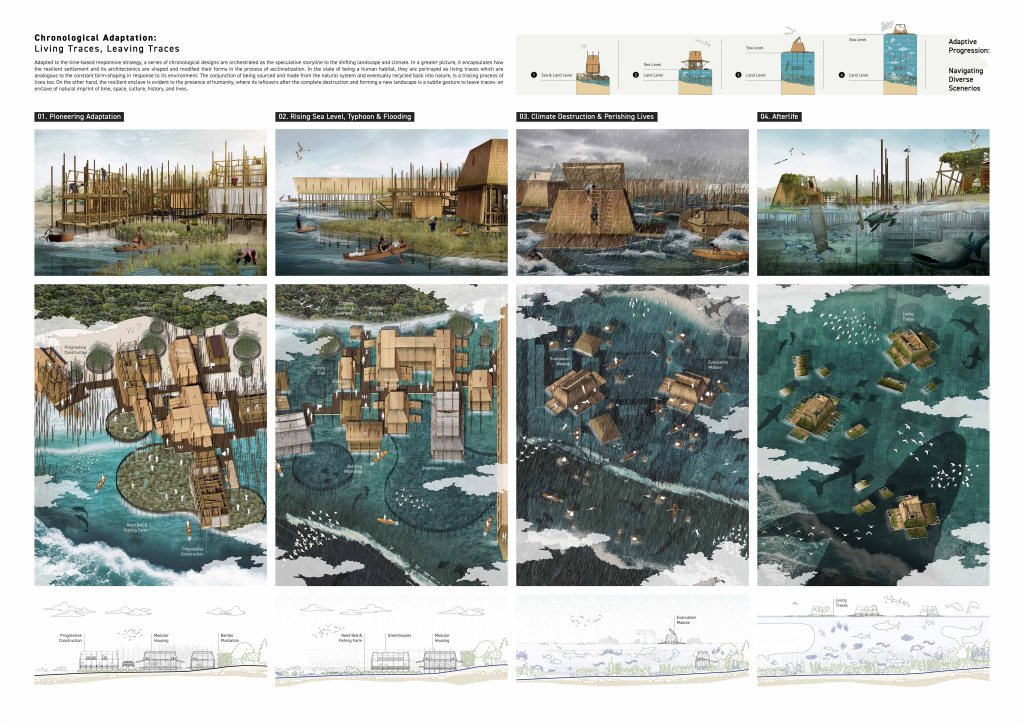
To think of the way to live through the gradual climate destruction and ending (or beginning) of the Earth, the proposal explores a narrative based on a chronological design responds to the changing landscape and climate. It portrays on how the people on Tawi-Tawi Island to lay the groundwork, innovate their traditions and cultures, resort to natural resources, and thrives with shifting built environment, until the day when it is fully destroyed. Such design theorem emerges from this ideal to live naturalistically, conceptualizing all lifeforms and resources as part of the natural ecosystem without diminishing the meanings of any existences.
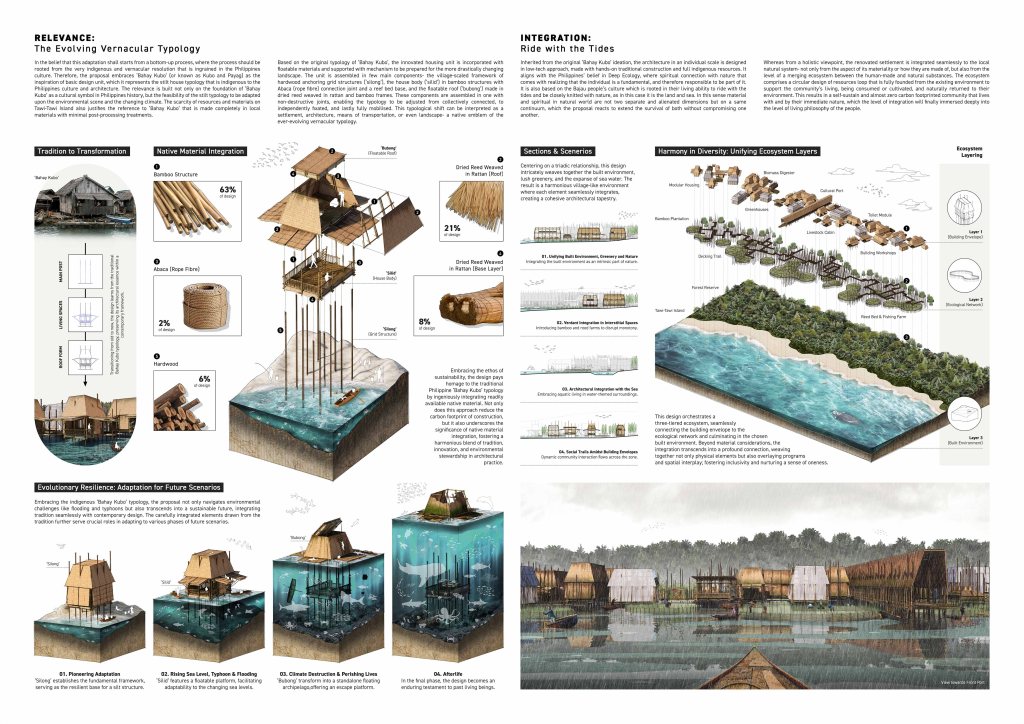
Complementing the ideal to live with nature, the design also takes its shape from blurring its definitive nature between the border of landscape and architecture. The meaning of architecture is no longer formally interpreted, but a constant improvisation through the process of adaptation with the immediate nature and its landscape. Such a built environment constructed with humane intuition and minimally processed natural resources, is perceived as one with the landscape. As time goes by and ruination comes, the architecture falls apart into pieces of its natural substances, and finally dissolves into the landscape to cultivate a new habitat for the next generation of lifeforms. It can be seen as an ecological timescape- the entropy of each natural substance is reformed into a lifecycle- epitomizing the shifting state from landscape to architecture, and eventually back to nature again.
 arch.yiyang