Ideas Competition for Pedestrianizing Jamsu Bridge, Seoul
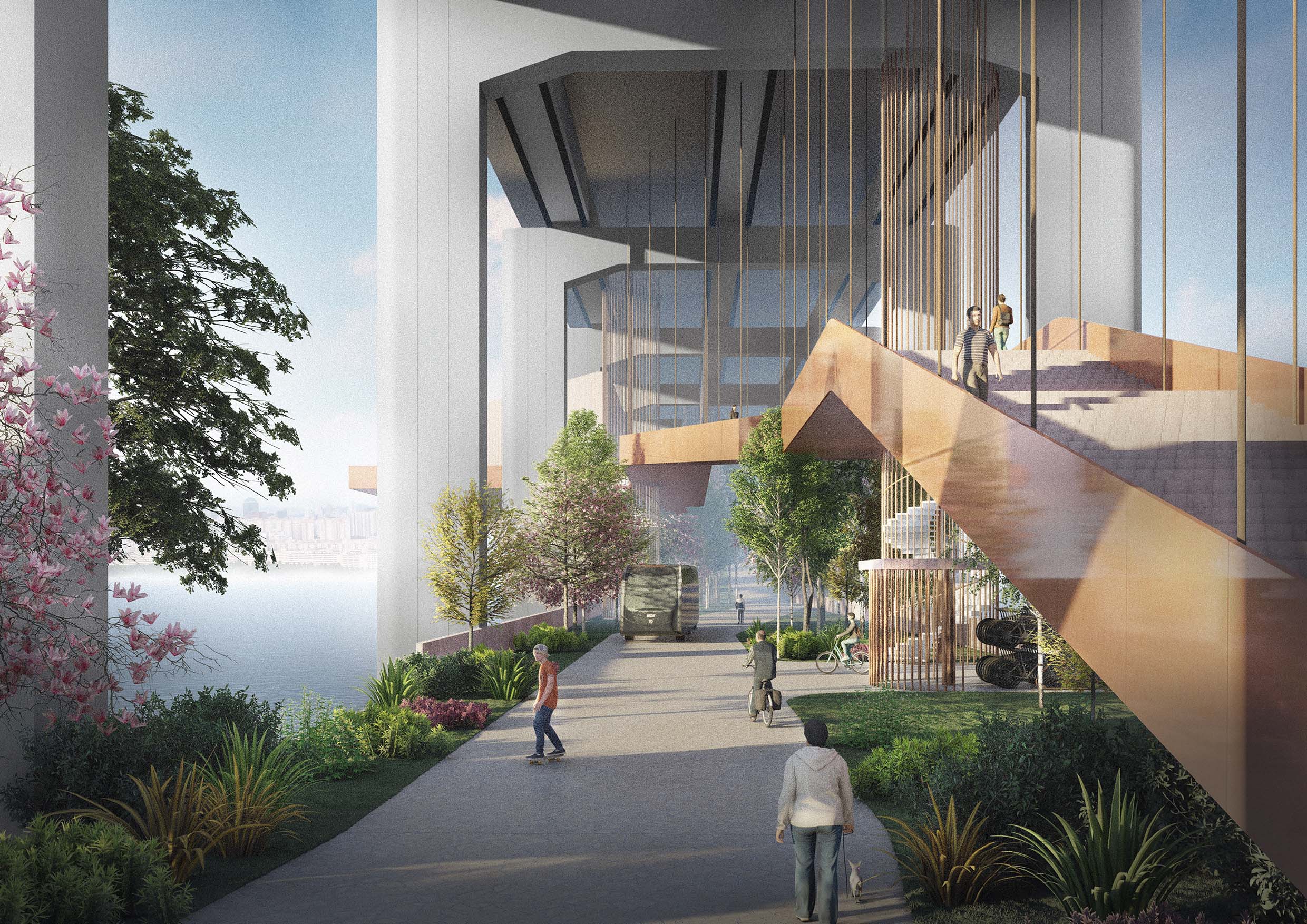
Pedestrianizing Jamsu Bridge
Design Statement: More than a Bridge
Corresponding with the ‘Great Hangang Project (Han River Renaissance 2.0)’, we envisions the full pedestrianization of Jamsu Bridge could bring transformation together of the bridge from a relatively mere infrastructural, mono-function and monotonous presence into a meaningful urban destination. Situated between the northern cultural and commercial Seobinggo area and the southern Banpo area with recreational and residential nature, the Jamsu Bridge is possibly a multifunctional platform to recollect the extensive urban programmes to connect with both ends.
Responding to such context, we wish to channel this energy from both ends through the revitalization of the bridge, as it is a plug-in cable for the existing urban programmes. It can be simultaneously an extension of mundane city life of Seoul’s people, or a new place resembling the landmark of Han River. We imagine the overall planning framework to be orchestrated in a rhythmic concept where multilayered programmes are interweaved along the Jamsu Bridge, where the linear representation of programmes are resembled in a continuum of new spatial language and architectonics.
The definition of the bridge is now expanded, it connects not only in terms of the mobility, but also recreational, cultural, civic, and nature aspects in changing scales. It should be a true urban vessel, where it becomes part of the urban walkability network of Seoul- the rhythm of lifeline and heartbeat within the city.
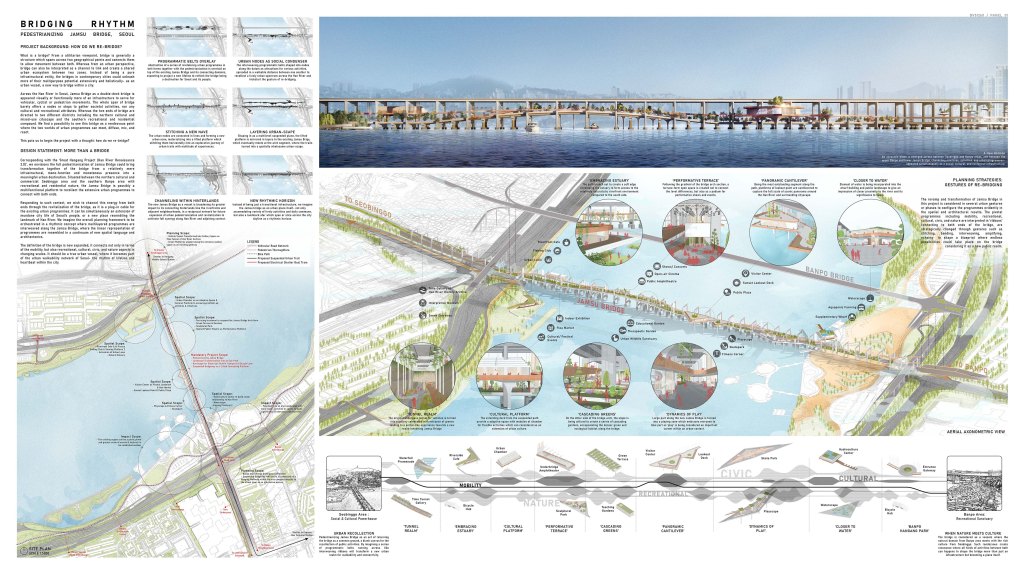
Planning Strategies: Gestures of Re-bridging
The revamp and transformation of Jamsu Bridge in this project is considered in several urban gestures or phases to configure the programmes evidently in the spatial and architectural results. The pivotal programmes including mobility, recreational, cultural, civic, and nature are interpreted in ‘ribbons’ connecting to both ends of the bridge, are strategically changed through gestures such as stitching, banding, interweaving, amplifying, echoing- to shape a blueprint where endless possibilities could take place on the bridge considering it as a new public realm.
Programmatic Framework: Rhythm in Bridging
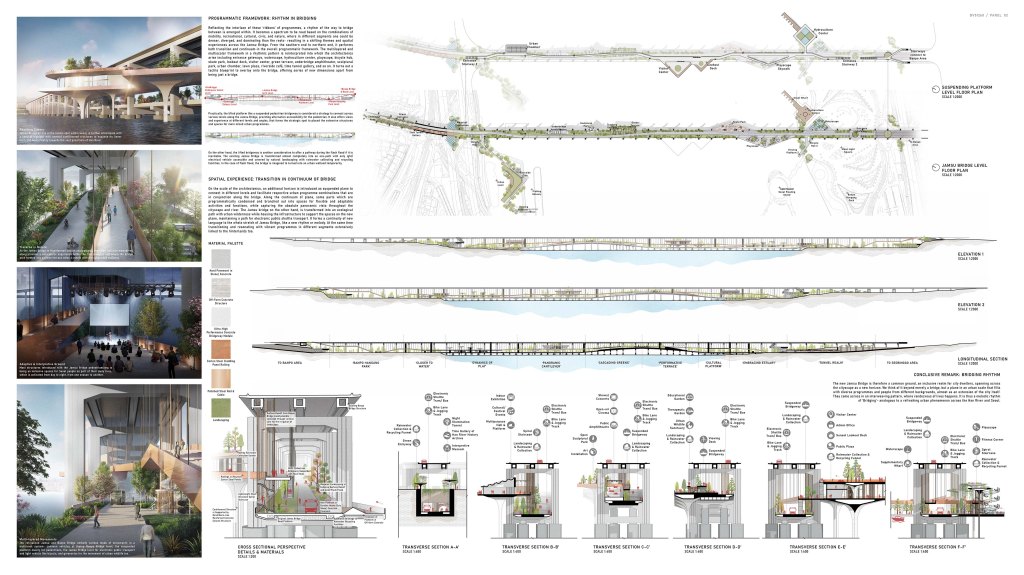
Reflecting the interlace of these ‘ribbons’ of programmes, a rhythm of the way to bridge between is emerged within. It becomes a spectrum to be read based on the combinations of mobility, recreational, cultural, civic, and nature, where in different segments one could be denser, diverged, and dominating than the rests- resulting in a shifting themes and spatial experiences across the Jamsu Bridge. From the southern end to northern end, it performs both transition and continuum in the overall programmatic framework. The multilayered and multiscalar framework in a rhythmic pattern is reinterpreted into which the architectonics arise including entrance gateways, waterscape, hydroculture center, playscape, bicycle hub, skate park, hammock groove, lookout deck, visitor center, green terrace, underbridge amphitheater, sculptural park, urban chamber, lawn plaza, riverside café, time tunnel gallery, and so on. It turns out a tactile blueprint to overlay onto the bridge, offering series of new dimensions apart from being just a bridge.
Spatial Experience: Transition in Continuum of Bridge
On the scale of the architectonics, an additional horizon is introduced as suspended plane to connect in different levels and facilitate respective urban programme combinations that are in conjunction along the bridge. Along the continuum of plane, some parts which are programmatically condensed and branched out into spaces for flexible and adaptable activities and functions, while capturing the absolute panoramic vista throughout the cityscape and river. The Jamsu bridge on the other hand, is transformed into an ecological path with urban wilderness while housing the infrastructure to support the spaces on the new plane, maintaining a path for electronic public shuttle transport. It forms a continuity of new language to the whole stretch of Jamsu Bridge, like a new rhythm or melody. At the same time transitioning and resonating with vibrant programmes in different segments extensively linked to the hinterlands too.
Conclusive Remark: Bridging Rhythm
The new Jamsu Bridge is therefore a common ground, an inclusive realm for city dwellers, spanning across the cityscape as a new horizon. We think of it beyond merely a bridge, but a plane in an urban scale that fills with diverse programmes and people from different backgrounds, almost as an extension of the city itself. They come across in an interweaving pattern, where rendezvous of lives happens. It is thus a melodic rhythm of ‘Bridging’- analogous to a refreshing urban phenomenon across the Han River and Seoul.
 arch.yiyang