Shortlisted, Land Art Generator Initiatives 2024 Design Challenge, Fiji

A Land Art Generator Pavilion for Marou Village in Fiji
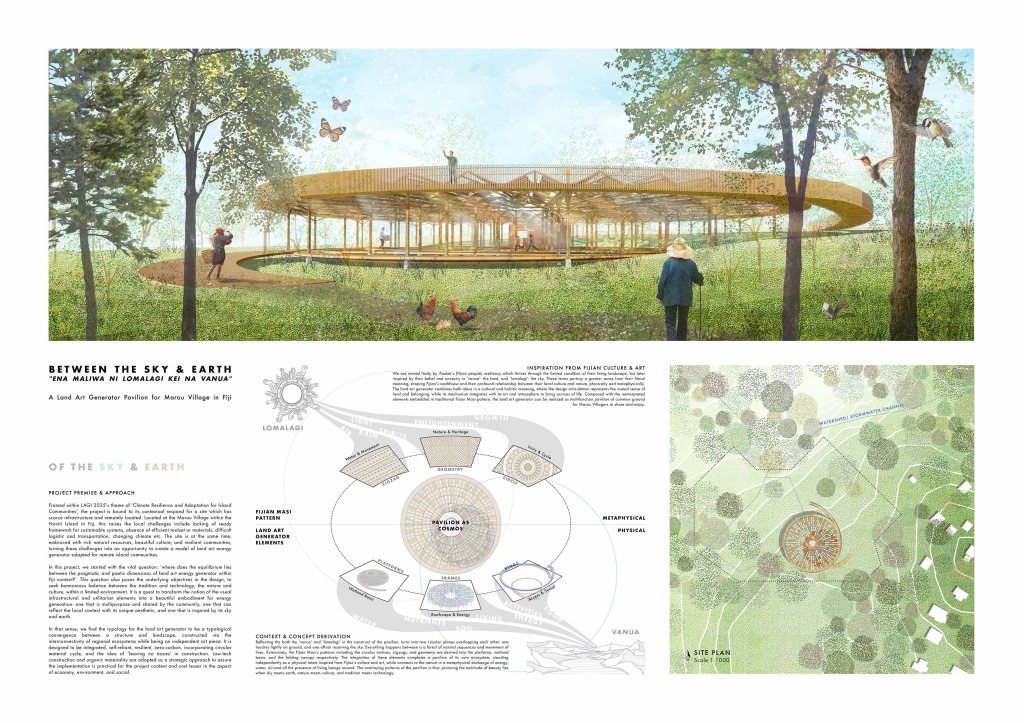
Framed within LAGI 2025’s theme of ‘Climate Resilience and Adaptation for Island Communities’, the project is bound to its contextual respond for a site which has scarce infrastructure and remotely located. Located at the Marou Village within the Naviti Island in Fiji, this raises the local challenges include lacking of ready framework for sustainable systems, absence of efficient toolset or materials, difficult logistic and transportation, changing climate etc. The site is at the same time, embraced with rich natural resources, beautiful culture, and resilient communities, turning these challenges into an opportunity to create a model of land art energy generator adapted for remote island communities.
In this project, we started with the vital question: ‘where does the equilibrium lies between the pragmatic and poetic dimensions of land art energy generator within Fiji context?’ This question also poses the underlying objectives in the design, to seek harmonious balance between the tradition and technology, the nature and culture, within a limited environment. It is a quest to transform the notion of the usual infrastructural and utilitarian elements into a beautiful embodiment for energy generation- one that is multipurpose and shared by the community, one that can reflect the local context with its unique aesthetic, and one that is inspired by its sky and earth.
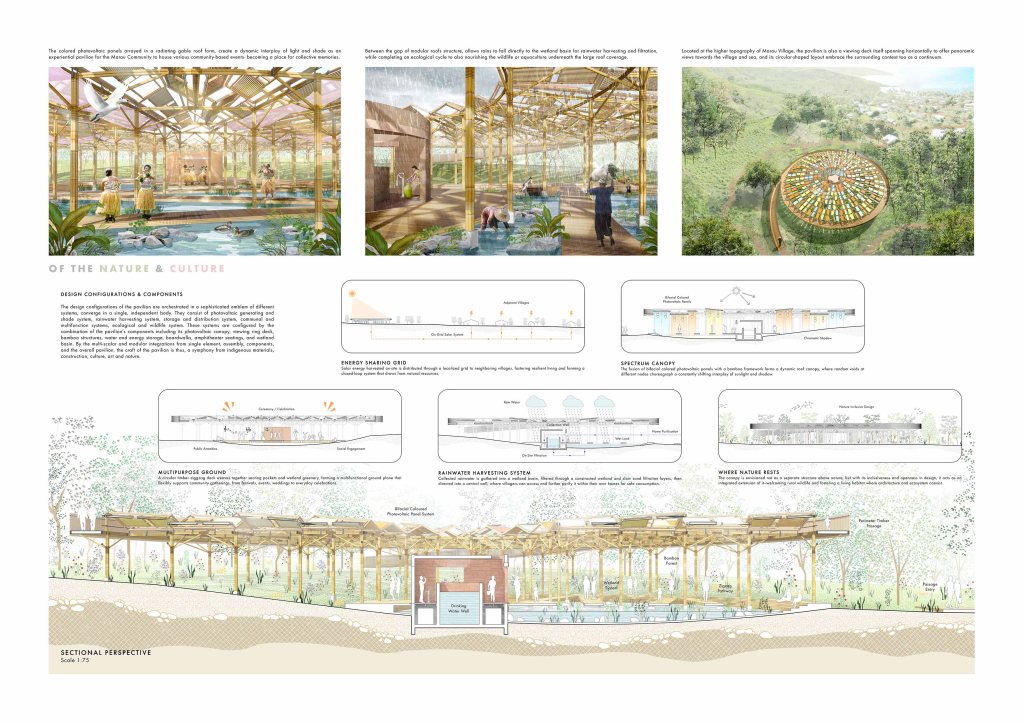
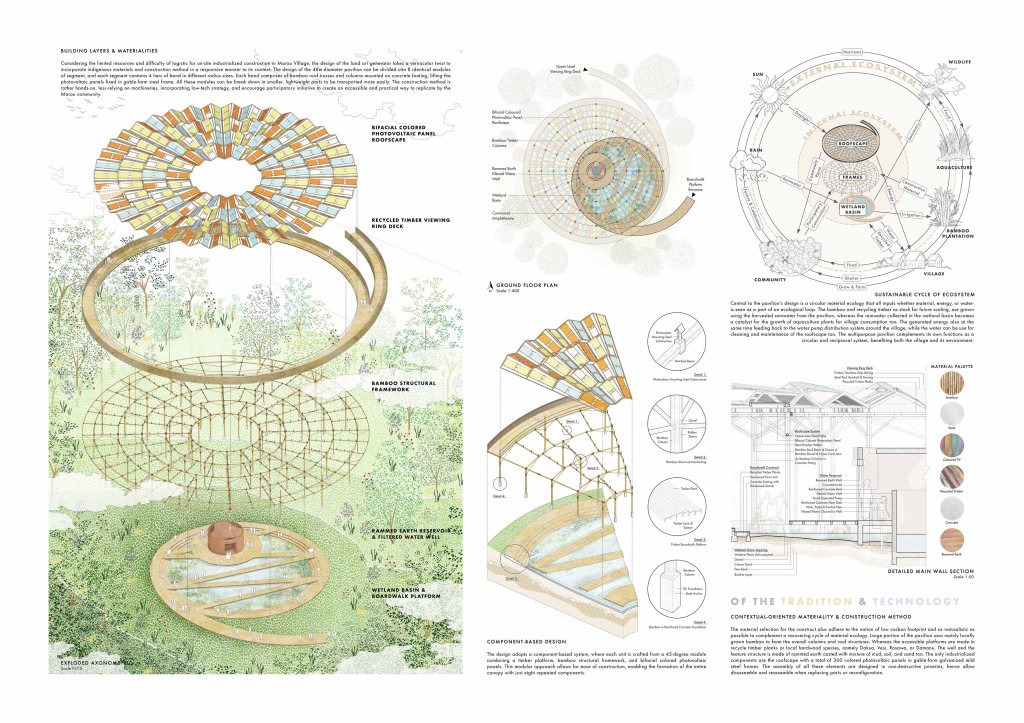
In that sense, we find the typology for the land art generator to be a typological convergence between a structure and landscape, constructed via the interconnectivity of regional ecosystems while being an independent art piece. It is designed to be integrated, self-reliant, resilient, zero-carbon, incorporating circular material cycle, and the idea of ‘leaving no traces’ in construction. Low-tech construction and organic materiality are adopted as a strategic approach to assure the implementation is practical for the project context and cost lesser in the aspect of economy, environment, and social. The pavilion upholds its ethos as the resources and material ecology that mirrors nature’s cycles. Every input- whether material, energy, or water- to be seen as a part of a loop rather than a one-way transaction.
 arch.yiyang