Kingspan Compliment Award, Buildner’s Microhome Competition 2024

Self-Sustain Microhome Design
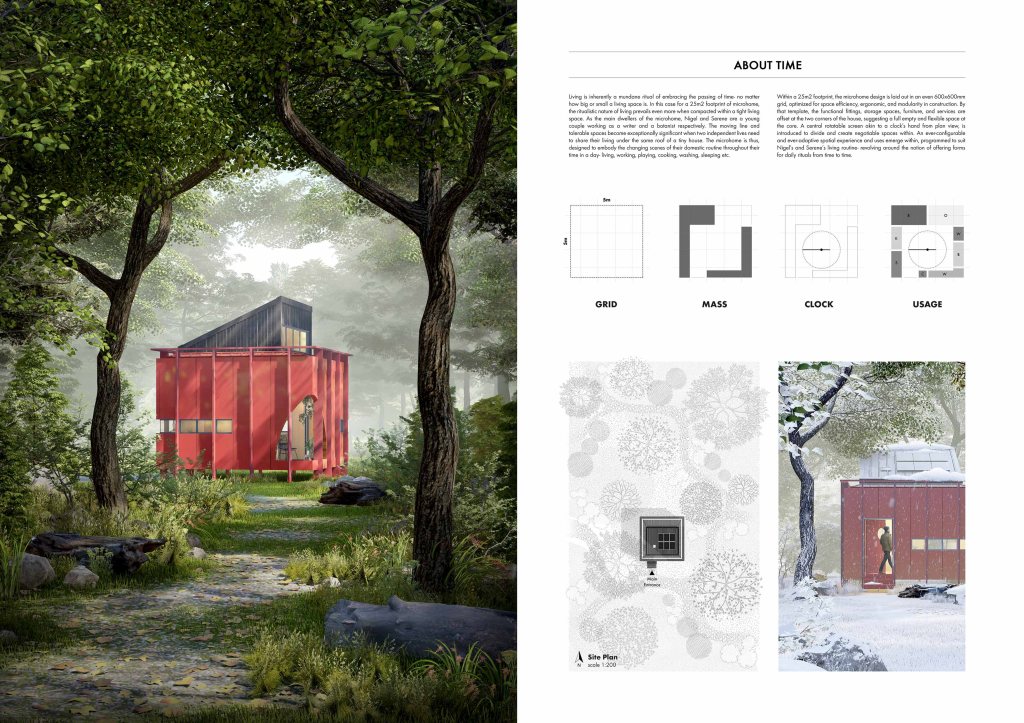
Living is inherently a mundane ritual of embracing the passing of time- no matter how big or small a living space is. In this case for a 25m2 footprint of microhome, the ritualistic nature of living prevails even more when compacted within a tight living space. As the main dwellers of the microhome, Nigel and Serene are a young couple working as a writer and a botanist respectively. The moving line and tolerable spaces become exceptionally significant when two independent lives need to share their living under the same roof of a tiny house. The microhome is thus, designed to embody the changing scenes of their domestic routine throughout their time in a day- living, working, playing, cooking, washing, sleeping etc.
Within a 25m2 footprint, the microhome design is laid out in an even 600x600mm grid, optimized for space efficiency, ergonomic, and modularity in construction. By that template, the functional fittings, storage spaces, furniture, and services are offset at the two corners of the house, suggesting a full empty and flexible space at the core. A central rotatable screen akin to a clock’s hand from plan view, is introduced to divide and create negotiable spaces within. An ever-configurable and ever-adaptive spatial experience and uses emerge within, programmed to suit Nigel’s and Serene’s living routine- revolving around the notion of offering forms for daily rituals from time to time.
Clockwork Living: A Day in the Microhome
Here, the microhome is imagined as a miniature of the couple’s living necessities, while also an amplifier of the couple’s routine lifestyles. With the functional elements tucked away as an envelope around the house, the central space becomes a flexible and negotiable space, which is profoundly impactful for a house in such scale. The revolving screen acts as a moving threshold, constantly demarcating the separated rooms or shared moments for both Nigel and Serene throughout the day. It allows the ever-changing state from public, to semi-private, and private at different zones of the house at different times. Even though the microhome is seemingly compact in size, it encapsulates everything resonating with the conscious living and awareness of time with a changing spatial configuration- embracing individual or shared mundane rituals in their respective lifestyles.

Timeless Construction: A Microhome Prototype
Designed in a well-composed grid and evenly dimensioned sizing, the microhome is made mainly from modular and prefabricated parts including a large portion of Kingspan products. They are intentionally designed in the suitable size for easier logistics and lightweight installation that can be assembled by the user without heavy machinery involved. By implementing component-based design and non-destructive joinery details, the building parts of the microhome can be recycled and reused, contributing to the renewable material ecosystem that can be potentially pioneered and initiated by Kingspan. In this sense, the notion of time in the tactility of the microhome’s materials can be further inherited through the way of its construction.

Towards Sustainability: Off-Grid Living System
Adopting the concept of Building Shearing Layers (Brand, 1994), the building layers including envelope, structure, services, fittings, and spaces that are compacted as the building shell provides not just a protective enclosure, but also offering full openness and flexibility in its central space. With the combination of low carbon footprint Kingspan materials and modular parts which can be disassembled and recovered for extended use, the microhome is fundamentally built in a passive sustainable body and frame. The active sustainable systems are integrated optimally to the house too including the rainwater harvesting tank, photovoltaic panels, Solatube tubular skylight, horizontal light shaft, composting toilet, and well-positioned ribbon windows. All of these features complement as a living system of the microhome to adapt in all kinds of climate and environment.

 arch.yiyang